Prevent knowledge loss in organisations – why decision making slows down and leadership gets overloaded
In many organisations, knowledge loss does not show up dramatically. No one is running through the office screaming.
Instead, something far more subtle happens: decisions take longer. Meetings multiply. And at some point, no one is quite sure anymore who actually decided what.
Officially, this is often called “due diligence.” Unofficially, it is usually something else.
A stable company with a quiet problem
The organisation in question is a tech company with around 350 employees. Stable in the market for years. Successful. Solid.
There is no crisis, no major disruption. But there is a growing concern: What happens when a large share of experience leaves the organisation in the coming years, while technological possibilities emerge faster than they can be meaningfully used?
At first glance, the symptoms seem harmless:
- decisions drag on
- knowledge sits with a small group of experienced employees
- new ideas are rare or not consistently followed through
- new hires are technically capable, but remain cautious
The most common sentence heard in conversations is: “It feels like no one really has ideas at the moment.”
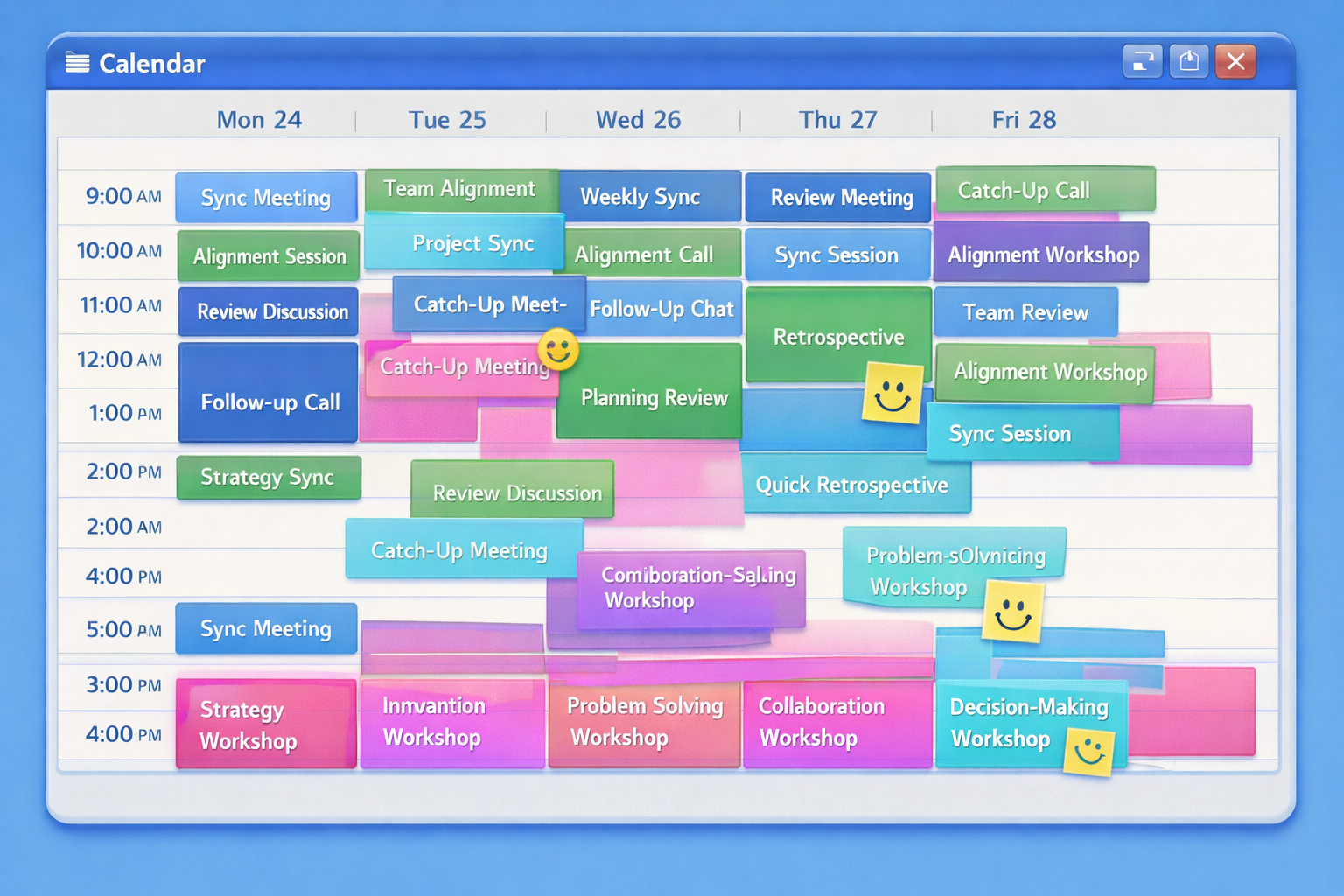
Another meeting? Or could we speed up decision making instead?
When decisions stop moving forward, organisations tend to react in a remarkably predictable way: they organise themselves better. Or, more precisely: they organise more.
Ideas are not rejected.
Decisions are not officially postponed.
And yet, many people start to smile – or roll their eyes – when terms like working group, alignment session or team workshop come up. Depending on how bad things have already become.
Phrases such as: “Let’s let this mature a little.” or “We need the right decision-makers at the table.” are usually meant positively. Right?
In practice, they often ensure that decision-making does not speed up decision making, but becomes further diluted.
When caution turns into a brake
What happens here is not individual failure. It is a systemic pattern.
Caution is mistaken for safety. And safety is equated with as little change as possible.
The company had been successful and stable for decades. So it did the obvious thing: it tried to change as little as possible.
The intention was stability.
The result is often stagnation at a very high energy cost.
“You just have to be strong.” No – today’s leaders are not too weak
Another pattern becomes visible very quickly: leaders are not bad at making decisions. They are overloaded.
They are expected to:
- secure performance
- keep teams stable → 3 Keys to a Healthy Workplace: How Neuroinclusion Strengthens Resilience and Flow
- preserve knowledge
- enable innovation → Neurodiversity fuels Innovation: 4 Phases Turning Idea Diversity into Impact
At the same time, clear guardrails are often missing:
- When do we discuss?
- When do we decide?
- When do we experiment?
- When do we stop?
Responsibility repeatedly lands with individuals. This may work in the short term, but it does nothing to reduce leadership overload in a sustainable way.
Relieving leaders does not mean changing people. It means creating clarity around who decides what, and when.
Collaboration in complex teams: know the difference between complicated and complex
In collaboration in complex teams, attempts to secure everything tend to backfire.
Complicated problems can be planned.
Complex systems cannot.
And yet, many organisations treat complexity as if it could be controlled through more alignment and coordination.
The consequences are predictable:
- ideas are evaluated too early
- new perspectives remain cautious
- knowledge is not shared naturally
Not out of unwillingness, but out of caution.
Why retaining talented employees matters more than hiring new ones
In such systems, organisations rarely lose “the bad ones.” They lose the quiet ones. The people who sense that thinking comes with risk.
To retain talented employees, benefits or employer branding alone are not enough. What makes the difference are working environments where:
- listening is not penalised
- complementarity has an explicit place
- difference is not explained away, but actively used
Belonging does not emerge from similarity. It grows from shared values that are actually lived.
An invitation to self-assessment
If you found yourself nodding while reading, these questions may be helpful:
- Where does decision-making take longer than necessary in your organisation?
- Where is caution used as an excuse for not deciding?
- Where do individual leaders carry too much responsibility?
- And where does knowledge disappear without anyone noticing?
Sometimes change does not begin with new initiatives, but with seeing your own system more clearly.
Would you like to assess your own situation?
On this page, you will find typical starting points organisations use when decision-making stalls, leadership needs relief, and collaboration is meant to become productive again.